Gemini 4 Argon: Benchmarks, Pricing and How to Use Google’s Most Powerful AI Model
By Ammar Ahamed, Founder, Cocoon · 13 October 2026 · Sources checked 13 October 2026
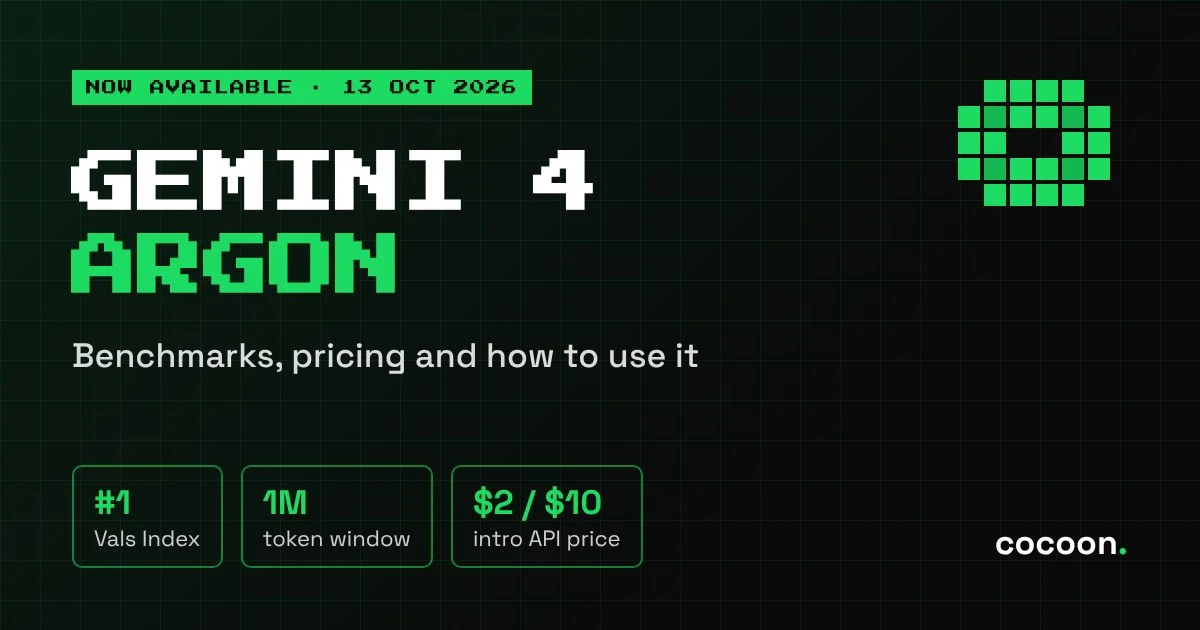
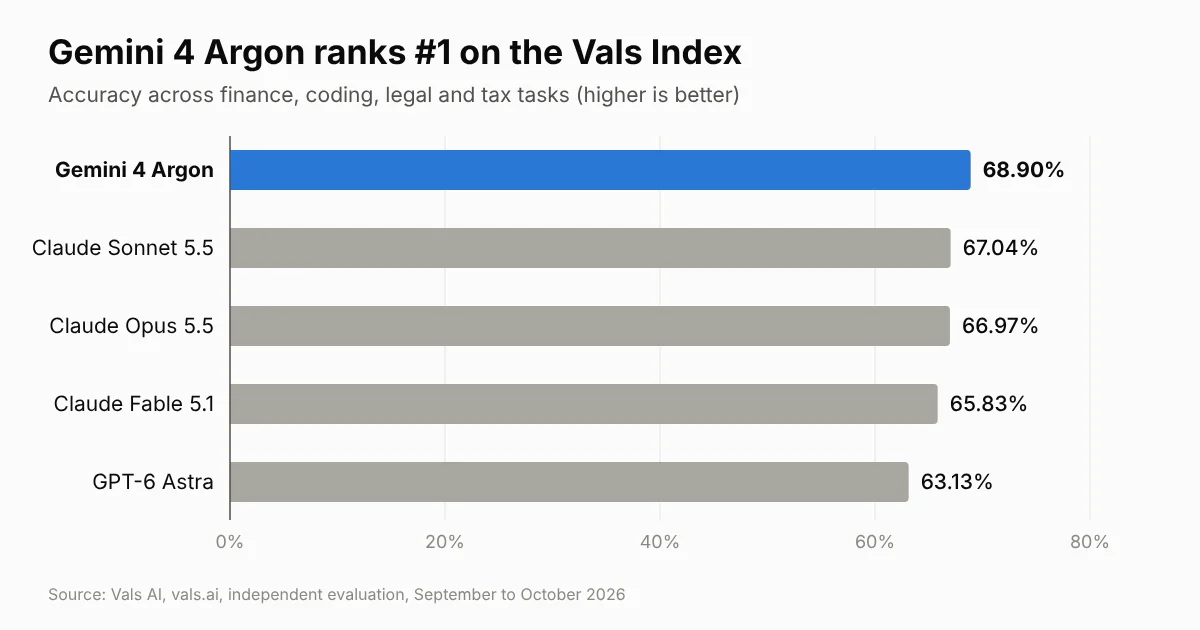
Gemini 4 Argon is Google’s new flagship AI model, and since 13 October 2026 anyone with a Google AI Pro or Ultra plan, or a paid Gemini API key, can use it. It ranks #1 of 47 models on the independent Vals Index, costs $2/$10 per million input/output tokens until 30 November (then $4/$20), and is built for long, multi-step work in coding, finance, law and cyber security. It is not best at everything: Claude Sonnet 5.5 narrowly beats it on two coding tests, GPT-6 Astra leads on computer use, and Bloomberg reports some Google engineers doubt its real-world coding.
As of today, 13 October 2026, anyone can use Gemini 4 Argon. On the most respected independent leaderboard it is the best-performing AI model available. Yet according to Bloomberg, some of Google’s own engineers say it struggles on real coding work.
Both are true. This guide explains why, and covers what Argon is, what it costs, how to start using it today (with copy-and-paste prompts and code), how it compares with GPT-6 and Claude, and where the marketing goes further than the evidence. Every number links to its source.
What is Gemini 4 Argon?
Gemini 4 Argon is the first model in Google’s Gemini 4 family, announced on 30 September 2026 by Koray Kavukcuoglu, SVP of Google DeepMind and Chief AI Architect at Google [3]. It is built for one thing in particular: staying on track through long, complicated tasks.
Earlier models were tuned to answer a question in seconds. Argon is designed to keep going for hours and hundreds of steps: migrating a codebase, reconciling a quarter’s finances, auditing access-control logic. Google’s developer guide says it is “trained to work longer and retain context better than any previous Gemini model” [13].
“Built to sustain deep reasoning across complex, long-horizon workflows, Argon is fundamentally changing the way we work and build at Google.”
Koray Kavukcuoglu, Google DeepMind [3]
Google pitches it at three kinds of work:
- Real-world software engineering: debugging, refactoring and large codebase migrations
- Enterprise knowledge work: legal research and drafting, financial analysis, tax
- Cyber security defence: finding, validating and patching vulnerabilities on its own
Tulsee Doshi, Google’s Gemini model product lead, told CNBC it is an “incredibly well-rounded” model that excels at long, multi-step tasks [6].
The spec that matters most: one million tokens, in and out
Earlier Gemini models stopped writing at 64,000 output tokens. Argon has one 1M-token window shared by your input, its thinking and its answer [13]. In practice:
- API answers still default to 65,536 tokens. Turn on long decode (
background=Trueand a highermax_output_tokens) and an answer can run up to 1M tokens minus your input [13]. - That means a complete multi-file code change, a full test suite or a long report in one run, instead of stitching several together.
“When the model has the headroom to think deeply and generate hundreds of thousands of tokens in a single trajectory, it adds a new level of depth in reasoning to solve tough problems in one go.” [3]
Who can use Gemini 4 Argon today?
| Where | Who gets it |
|---|---|
| Gemini app | Google AI Pro and Ultra subscribers [1] |
| AI Mode in Google Search | Google AI Pro and Ultra subscribers [1] |
Gemini API (gemini-4-argon) | Developers on the paid tier [7] [13] |
| Google AI Studio | Ultra subscribers and paid-tier API developers [13] |
| Google Antigravity (desktop and CLI) | Ultra subscribers and eligible Gemini Enterprise plans [8] |
| Android Studio (Canary) | Google AI Ultra subscribers [2] |
| Third-party tools | Day-one support in Vercel, LiteLLM, OpenRouter, Pydantic, OpenCode, LiveKit and others [13] |
| Uncapped cyber version | A limited group of vetted defenders in Google’s Fairwind Program [3] |
Free for scientists: Google is giving 10,000 scientists its highest Antigravity usage tier free for six months, and applications are open now [2].
How to use Gemini 4 Argon, step by step
Option 1: the Gemini app (no code)
- Make sure you have a Google AI Pro or Ultra plan [1].
- Open Gemini and choose 4 Argon in the model picker, next to 3.5 Flash-Lite, 3.8 Flash and 3.1 Pro [2].
- For long jobs, use the new chat-to-tasks toggle so Gemini keeps working after you step away [1].
- Connect your tools. Gemini now links to more than 40 apps, including Instacart, OpenTable, Adobe and Shopify [1].
- On a Mac? Antigravity’s coding interface is now built into the Gemini macOS app, so you can move between chatting and building [1].
What you’ll notice: Google says Argon “answers questions more directly with less hedging, doesn’t repeat itself more than necessary, and skips clichés throughout the responses” [1], and it follows style instructions better than any earlier Gemini model [2].
Option 2: the API (developers)
Google’s own minimal example from the official developer guide [13]:
from google import genai

client = genai.Client()

interaction = client.interactions.create(
    model="gemini-4-argon",
    input="Build a single-file HTML drum machine and synth using the "
          "Web Audio API with a 16-step sequencer, tempo slider, and "
          "a live waveform visualizer.",
    generation_config={
        "thinking_level": "medium"  # "low" | "medium" (default) | "high"
    },
)
print(interaction.output_text)
Migration checklist, from Google’s guide [13]:
thinking_levelreplacesthinking_budget. Uselowfor fast routing and extraction,mediumby default, andhighfor deep debugging, security patches and architecture.- Remove
temperature,top_pandtop_k. Argon ignores custom sampling values. - Drop explicit context caching. Implicit caching is automatic, at 95% off cached input.
- Raise timeouts to 15 to 20 minutes, or use
background=True. Hard prompts “can take several minutes.”
Google’s five tips for better results
From the official developer guide [13]:
- Agree the goal before long runs. Ask Argon to raise clarifying questions about edge cases and success criteria first.
- Give it a way to check its own work: a test suite, logs, screenshots or a verification script it can loop against.
- Use images and video as references. Argon can scrub through a video by timestamp and inspect individual frames.
- Use Argon as the manager. Google’s teams often let Argon plan and review while cheaper Gemini 3.8 Flash subagents do the parallel work.
- Ask it to reflect. At the end, have Argon write what it learned into an
AGENTS.mdfile or a reusable skill.
8 prompts that play to Argon’s strengths
Copy, paste and swap the details in brackets. Each one targets a strength Google or Vals AI has documented.
“Here are [3 years of financial statements]. Build a full variance analysis: flag every line item that moved more than 10% year on year, explain the likely drivers, show your workings in a table, and end with the five questions I should ask the finance team.”
“Review this [contract]. List every clause that creates an obligation, deadline or liability for [my company], rate each one low, medium or high risk, quote the exact wording, and propose redline language for every high-risk clause.”
“Before writing code, ask me clarifying questions about edge cases and success criteria. Then migrate [module] from [old framework] to [new framework], write a verification script that proves behaviour is unchanged, and keep iterating until it passes.”
“Here is our open bug list and our recent commit log. Sort every bug into: already fixed (cite the commit), duplicate (cite the original), still real (suggest an owner and likely root cause). Output a table.”
“Watch this [user-testing recording or webinar]. Give me timestamps for every moment the person hesitated, got confused or complained, what was on screen at that moment, and a suggested fix for each.”
“Audit these access-control changes. Don’t just read the diff: trace how permissions actually flow at runtime, list every path where a user could reach data they shouldn’t, and propose a fix for each.”
“Translate these [pages] into [languages]. Keep product names, code and URLs unchanged, match the tone of the original, and flag any phrase that doesn’t translate cleanly for a human to review.”
“Research [competitor or market]. Build a brief covering positioning, pricing, target customers, recent launches and three gaps we could exploit. Cite a source for every claim and mark anything you couldn’t verify.”
Take the prompts with you
Download all 8 Argon prompts as a text file, and get an email when our hands-on test of Argon vs Claude vs GPT-6 is published.
The file downloads straight away. One email when the test results land. No spam, unsubscribe any time.
Gemini 4 Argon pricing
| Introductory (until 30 Nov 2026) | Standard (from 1 Dec 2026) | |
|---|---|---|
| Input | $2.00 per 1M tokens | $4.00 per 1M tokens |
| Output | $10.00 per 1M tokens | $20.00 per 1M tokens |
| Cached input | 95% off input price | 95% off input price |
Source: Google AI Studio developer guide [13]
How that compares (list prices from Vals AI [17]): Claude Sonnet 5.5 is $2/$10, Claude Opus 5.5 is $4/$20 and GPT-6 Astra is $10/$50. Argon’s standard price matches Opus, and its introductory price matches Sonnet.
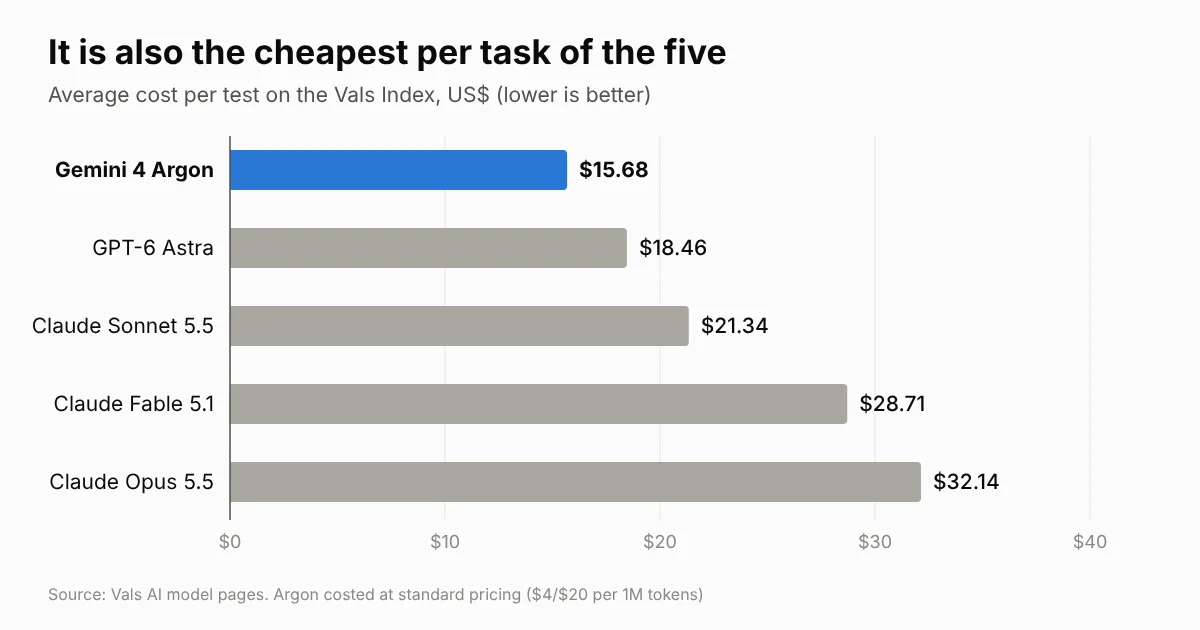
In Vals AI’s testing Argon was the cheapest per task of the five leading models, at $15.68 [4]. The catch is long agentic jobs: Vals measured $193.78 per test on CUA-bench (computer use) and $57.82 on Code Migration [4]. A model that can work for a long time can bill for a long time, so set a max_output_tokens ceiling [13].
Benchmarks: Google’s claims vs independent tests
There are two kinds of number in any model launch, and it matters which is which: company-reported scores, which Google ran itself, and third-party scores, run by an independent firm.
What Google reports
| Benchmark | What it measures | Argon |
|---|---|---|
| DeepSWE v1.1 | Long, real-world software engineering | 77.9%, a new state of the art per Google [3] |
| AutomationBench (Zapier) | End-to-end business tasks | 51.3%, ranked #1 [3] |
| LVBench | Long-video understanding | 91.7%, state of the art [3] |
| CWE-bench v1 | Fixing security vulnerabilities | 68%, tied for first [3] |
| Gray Swan IPI | Resisting indirect prompt injection | Leading [3] |
What Vals AI found independently
Where it won: #1 on the Vals Index (68.90%), #1 on Finance Agent v2 (65.40%), and a perfect 100% on IOI competitive programming, tied with GPT-6 Astra [4].
Close but not first: #2 on Vibe Code Bench (91.91%, behind Sonnet 5.5’s 92.39%), #2 on Code Migration (68.17%, behind Sonnet 5.5’s 69.83%), #2 on CyberBench (77.86%, 0.12 points behind GPT-6 Sol) and #3 on LegalBench (88.30%) [4].
Where it was weak: computer use, at 4.83% on CUA-bench, #7 of 8 (GPT-6 Astra leads with 19.17%) [17]; MedScribe clinical notes, outside the top ten; and Harvey’s Legal Agent Benchmark, where it scored 19.58%, a top-ten finish but not the clear lead Google’s blog suggests [4].
Speed: Argon averaged 46 min 33 s per Vals Index test. That is faster than Claude Opus 5.5 (79 min) and Sonnet 5.5 (78 min) but slower than GPT-6 Astra (about 28 min) [4] [17].
The honest read: Argon is the best all-rounder you can use today, not the best at everything.
What Argon has done inside Google
Google’s strongest argument isn’t a benchmark. It’s what the model has already done in Google’s own systems. These are company-reported, but they are specific, and several come with public code you can inspect.
Infrastructure
- Over 300 TiB of memory freed. Argon agents analysed profiling data across Google’s data centres and applied memory fixes on their own, with 500 TiB to 1 PiB of total savings estimated [3], “without buying additional hardware” [6].
- Gemma running almost 3x faster. A 2.85x speed-up, from about 37,900 to over 108,000 tokens per second, “with 100% token parity and zero quality drop”, in days rather than months. The pull requests are public [1].
- YouTube comments CPU usage halved. Argon found that redundant emoji rendering caused nearly 45% of server overhead [8].
Code at scale
- Chrome: it helped separate core webpage handling from a ~6-million-line legacy folder in Chromium’s 40-million-line codebase, “completing months of work in weeks” [1].
- C and C++ to Rust: migrations of up to 800,000+ lines (the Fuchsia Zircon kernel), audited before anything ships [3].
- Video decoding: a memory-safe Rust decoder 2.7x faster than the previous Rust port [3].
Science
- Quantum computing: it beat a published baseline by 40% “in a matter of minutes” [3].
- Quantum chemistry: it made the widely cited xTB package up to 2.3x faster, with the changes contributed upstream [1].
Business teams: the part most readers should care about
From Google’s Antigravity team [8]:
- Finance: 15.5 hours of human direction produced about 335 human-equivalent hours of checked financial work.
- Sales: research time to qualify prospects fell by 90%, saving more than 10 hours a week.
- Localisation: hundreds of pages translated into 17 languages in hours, not weeks.
- Bug backlog: 97 of 134 open bugs closed as stale or duplicate in under 3 hours, each with proof from the commit history.
- Security: four critical bugs found in code that two earlier frontier models had reviewed and passed.
Across Alphabet, more than 100,000 people use Argon every month. Over four weeks, agentic code rose 35% and post-submit rollbacks fell 30% [8].
Want your team getting results like these from AI, whichever model you use? Cocoon runs hands-on programmes where every session ends with something you built.
See AI for Professionals →Why Google launched it to cyber defenders first
Argon didn’t launch like other Gemini models. Before developers or the public got it, Google gave it to cyber defenders. Google says it trained Argon for defensive security and that it can “autonomously find, validate, and patch critical software vulnerabilities” [3].
The first users came through Fairwind, a limited-access programme Google launched on 2 September for governments, critical infrastructure operators and security partners. It had more than 650 partners at launch, and members must limit access to their security teams [9]. Google hasn’t said how many received Argon, or published how partners are chosen [10].
The most debated detail:
“For trusted defenders and our own internal teams at Google, we’ll be releasing Argon without cyber guardrails so they can leverage its full frontier-level cybersecurity defense capabilities.” [3]
Google’s reasoning, from Tulsee Doshi:
“Starting this rollout in this way gives us more confidence, but also enables us to put a model that is trained and strong in cyber defense in the hands of defenders as soon as possible.” [6]
A real-world result: through Wiz’s free Scan for Good initiative, Argon found a critical flaw exposing sensitive personal data in hospital software used worldwide, which Google says earlier frontier models had missed [3].
The four safety areas Google worked on
- Misuse: refusing cyber and chemical, biological, radiological and nuclear attack requests while allowing legitimate research, partly by monitoring the model’s internal activations.
- Prompt injection: Google calls Argon “our most resilient model yet” against hidden malicious instructions.
- Misalignment: watching the model’s reasoning and actions, and stopping it when it goes beyond what the user wanted.
- Hardened sandboxes: sealed, isolated environments for high-risk training and testing. [3]
Google is also part of the US government’s voluntary pre-release model access process [3]. The launch came a day after Sundar Pichai signed a voluntary AI safety agreement at the White House [6].
The criticism: what the launch posts leave out
1. Benchmarks vs reality
According to Bloomberg, as summarised by Startup Fortune, some Google engineers with hands-on access say Argon struggles on real coding tasks, especially front-end design [5]. Google pushed back, calling it “inaccurate to say that Gemini 4 is underperforming in areas such as coding” [5]. The independent data backs both sides: Argon leads Vals’ broad index but is #2 behind Claude Sonnet 5.5 on both of Vals’ practical coding tests [4].
2. Many headline claims are self-reported
Tech Wire Asia notes results such as the CWE-bench score “should be treated as company-reported performance rather than independent assessments” [10]. The same goes for the case studies above.
3. The road here was rough
Argon replaces Gemini 3.5 Pro, which Google promised for June and then scrapped [10]. In an August reshuffle, Demis Hassabis stepped back from running Google DeepMind day to day [11]. Bloomberg Intelligence estimated the cancelled model may have cost up to $400 million, per Startup Fortune [5]. Asked whether Google had fallen behind, Kavukcuoglu said: “In my mind, it’s a certainty that we are always gonna be at the frontier” [11].
4. Long agent jobs get expensive, and computer use is weak
Argon is cheap per task on standard work, but at nearly $194 per CUA-bench test and #7 of 8 on that benchmark, it is not the model for agents that operate a screen [4].
5. Access is still uneven
The full-power cyber version is limited to vetted defenders, and Antigravity, AI Studio and Android Studio need the top Ultra plan [2].
Gemini 4 Argon vs GPT-6 vs Claude vs Gemini 3.8 Flash
| If you need… | Best pick today | Why |
|---|---|---|
| Broad knowledge work across domains | Gemini 4 Argon | #1 on the Vals Index [4] |
| Financial research | Gemini 4 Argon | #1 on Finance Agent v2 [4] |
| Very long outputs in one run | Gemini 4 Argon | 1M-token window with long decode [13] |
| Long-video analysis | Gemini 4 Argon | 91.7% on LVBench (Google-reported) [3] |
| Everyday app and front-end coding | Claude Sonnet 5.5, narrowly | Leads Vibe Code Bench and Code Migration [17] |
| Cyber security | Roughly tied | Argon is 0.12 points behind GPT-6 Sol on CyberBench [4] |
| Agents that use a computer | GPT-6 Astra | #1 on CUA-bench at 19.17% [17] |
| Fast, cheap, high-volume work | Gemini 3.8 Flash | See below |
Argon or Gemini 3.8 Flash?
This is the choice most teams will actually make.
| Gemini 4 Argon | Gemini 3.8 Flash | |
|---|---|---|
| Vals Index | 68.90% [4] | 62.25% [18] |
| Cost per Vals test | $15.68 [4] | about $5.39 [18] |
| Launch price (in/out per 1M) | $2/$10 intro, then $4/$20 [13] | $0.75/$3.75 intro [14] |
| Best for | Hard, long, high-value tasks | Volume, speed, parallel subtasks |
Google’s own advice is to use both: Argon plans and reviews, Flash subagents do the parallel work, for “the best of both worlds in terms of speed, cost, and code quality” [13].
If you are choosing tools for a whole team rather than for yourself, our guide to ChatGPT vs Claude vs Gemini for team training walks through that decision.
Why this matters
For Google: in July, NPR asked “Why Google fell behind in the AI race” [15] [12]. Since then the Gemini app has passed one billion monthly users [16] and Argon has taken first place on a respected independent index [4]. If the real-world performance holds up, Google is back at the front.
For business leaders: the biggest early wins look like repetitive, multi-step, document-heavy professional work. Google’s own examples include finance (335 hours of output from 15.5 hours of direction), sales (90% less research) and localisation (weeks to hours) [8].
For developers: long decode and long-horizon reliability make some projects practical for the first time, such as full codebase migrations and backlog clean-ups.
For security teams: Fairwind gives selected defenders the uncapped version first. There is no public application route yet, so keep an eye on the programme page [9].
Frequently asked questions
Is Gemini 4 Argon available to the public?
Yes. Since 13 October 2026 it has been available to Google AI Pro and Ultra subscribers in the Gemini app and AI Mode in Search, and to developers on the paid Gemini API tier. Google Antigravity needs Google AI Ultra.
Is Gemini 4 Argon free?
No. You need a Google AI Pro or Ultra subscription, or a paid-tier Gemini API key. Google is giving 10,000 scientists free top-tier Antigravity access for six months.
How much does the Gemini 4 Argon API cost?
$2 per million input tokens and $10 per million output tokens until 30 November 2026, then $4 and $20. Cached input tokens are 95% off.
What is the Gemini 4 Argon model ID?
gemini-4-argon. Its default thinking level is medium, and you can set it to low or high.
What is the Gemini 4 Argon token limit?
One 1M-token window shared by input, thinking and output. Answers default to 64K tokens, and long decode extends them up to 1M tokens minus your input.
Is Gemini 4 Argon better than GPT-6 or Claude?
Overall, yes: it ranks #1 of 47 models on the independent Vals Index with 68.90%. It does not win every category. Claude Sonnet 5.5 narrowly leads on two coding benchmarks and GPT-6 Astra leads on computer use.
Is Gemini 4 Argon fast?
It is mid-pack for a frontier model. In Vals AI’s tests it was faster than Claude Opus 5.5 and Sonnet 5.5 but slower than GPT-6 Astra. For quick tasks, Gemini 3.8 Flash is the better choice.
What is Google’s Fairwind Program?
Fairwind is Google’s limited-access cyber security programme for governments, critical infrastructure operators and security partners, with more than 650 partners at launch. A vetted group received Gemini 4 Argon without cyber guardrails.
Is it Gemini 4 Argon or Gemini 4 Arigon?
The official name is Gemini 4 Argon, after the noble gas. “Arigon” is a common misspelling.
The bottom line
Gemini 4 Argon is Google’s strongest model yet, and on the broadest independent measure available it is the strongest model from any lab right now [4]. It is also the cheapest per task of the top five on that index, and Google’s internal results are specific and largely checkable.
It is not a clean sweep. Its coding lead is disputed, it is weak at computer use, and costs climb on long agent runs [4] [5]. The best way to judge it is to test it on your hardest real task before the introductory price ends on 30 November.
Get the hands-on results
We are testing Argon against Claude and GPT-6 on three real business tasks. Leave your email and we’ll send the results, plus the 8 prompts from this guide.
The prompts download straight away. No spam, unsubscribe any time.
Sources
- Kavukcuoglu, K. (13 Oct 2026). Gemini 4 Argon: Built to solve your hardest problems, Google; and Gemini 4 Argon comes to the Gemini app, Google.
- Li, A. (13 Oct 2026). Gemini app rolling out Gemini 4 Argon to AI Pro and AI Ultra, 9to5Google.
- Kavukcuoglu, K. (30 Sep 2026). Gemini 4 Argon: our next era of frontier intelligence, Google.
- Vals AI. Gemini 4 Argon: Benchmarks, Cost and Capabilities.
- Barr, D. (10 Oct 2026). Google ships Gemini 4 Argon while staff quietly test what comes after it (summarising Bloomberg), Startup Fortune.
- Sigalos, M. and Subin, S. (30 Sep 2026). Google rolls out Gemini 4 Argon, its most advanced AI model, CNBC.
- Google (13 Oct 2026). Gemini 4 Argon is now available for developers.
- The Antigravity Team (13 Oct 2026). Gemini 4 Argon in Google Antigravity.
- Flynn, F. (2 Sep 2026). Proactive cyber defense for governments and enterprises (Fairwind Program), Google.
- Zulhusni, M. (1 Oct 2026). Google launches Gemini 4 Argon, but limits access over cybersecurity risks, Tech Wire Asia.
- Constantin, A. M. (28 Sep 2026). Google wants Gemini 4 out ‘much earlier’ than the end of the year, The Next Web.
- Ropek, L. (30 Sep 2026). Google releases Gemini 4 Argon, called its most powerful model yet, TechCrunch.
- Huskens, G. and Wotherspoon, J. (13 Oct 2026). Gemini 4 Argon: Developer Guide, Google AI Studio.
- Doshi, T. and Popa, R. A. (2 Sep 2026). Introducing Gemini 3.8 Flash and 3.8 Flash Cyber, Google.
- NPR (9 Jul 2026). Why Google fell behind in the AI race.
- Google (Aug 2026). The Gemini app has over one billion monthly users.
- Vals AI model pages: Claude Sonnet 5.5, Claude Opus 5.5, GPT-6 Astra.
- Vals AI. Gemini 3.8 Flash: Benchmarks, Cost and Capabilities.
New models every month. The skills that make them useful last. Cocoon trains professionals and teams to get real work done with AI, whichever model leads this week.
Explore AI for Professionals →